
Motorhead Articles
Get Your Marketing in Gear
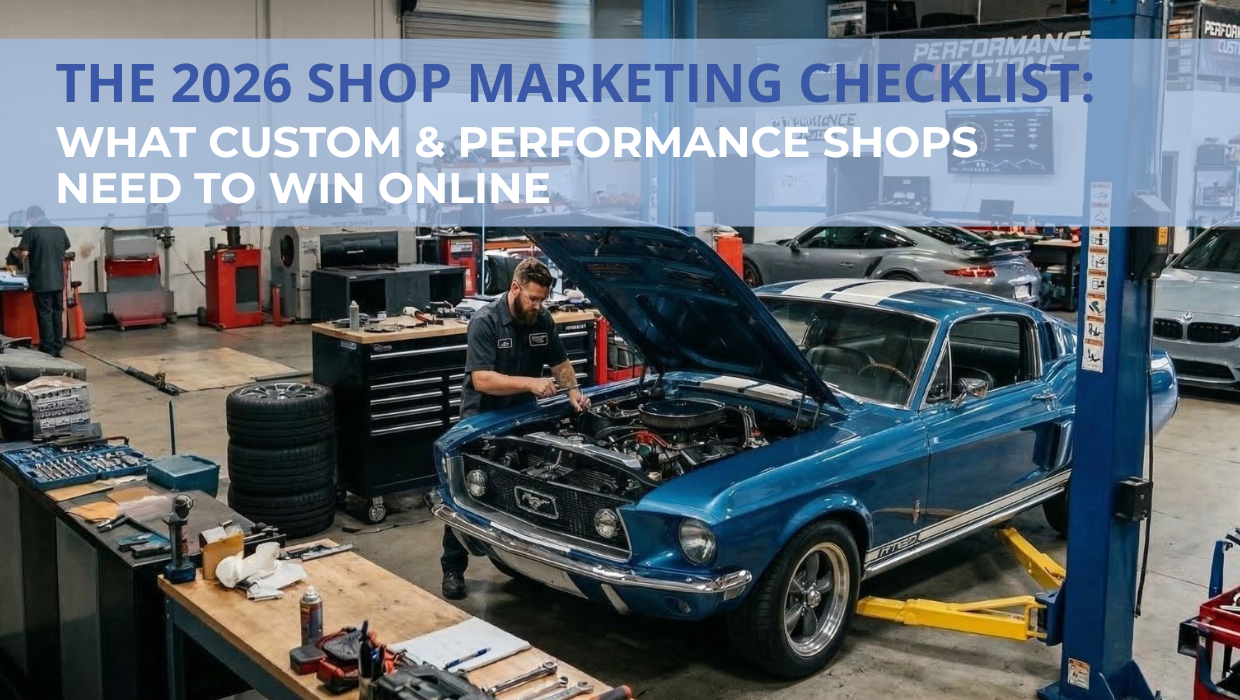
The 2026 Shop Marketing Checklist: What Custom & Performance Shops Need to Win Online
Strategy · Visibility · Growth
The essential 2026 marketing checklist for custom and performance shops relies on consistent fundamentals: maintaining an updated Google Business Profile, documenting shop work weekly, collecting targeted customer reviews, and answering specific customer questions to capture high-quality leads.
You started your shop because you love the work. The sound of a cammed idle. The satisfaction of perfectly shaped metal. The moment a customer sees their finished build for the first time.
The reality is simple: if someone can't find you online, they can't hire you. This isn't about dancing on TikTok or chasing trends. It's about building a digital foundation that supports your reputation, your referrals, and your long-term growth. Here's a practical, no-fluff checklist for custom, restoration, and performance shops that want to compete online.
Start With Google Business Profile
If you do nothing else on this list, do this. Your Google Business Profile is one of the most powerful local marketing tools available, and it's free. When someone searches for "custom car shop near me" or "C10 restoration shop," your profile determines whether your profile appears in the results.
Here's what matters: choose the correct business category, keep your hours up to date, upload photos weekly (shop progress, finished builds, team shots), collect at least 20 high-quality reviews, and post occasional updates on recent projects or shop news. Also, encourage happy customers to leave detailed reviews. Specific language, such as "frame-off 1970 Chevelle restoration," helps Google understand exactly what you do. Details matter.
Build a Website That Earns Trust in 30 Seconds
Before a customer calls, they look. They check your website. They scan your photos. They read reviews. They're looking for proof that you're legitimate, skilled, and busy. Your website has to answer three questions immediately: What do you specialize in? Who do you serve? And how do they contact you?
Your homepage should have a clear headline that states your specialty (not "Welcome to Our Shop" but "Classic Ford Restoration in Austin, Texas"), real photos of your work instead of stock images, Google reviews displayed prominently, a simple contact form and clickable phone number, and your location and service area clearly listed. If your site doesn't clearly state what you do and where you do it, Google and AI tools can't categorize you properly. Clarity wins every time.
Use Social Media as Documentation
Social media isn't about going viral. It's about documentation. You're already doing the work. Capture it. The shops that grow consistently are posting before-and-after transformations, in-progress build updates, shop team photos, customer delivery moments, and the occasional educational tip. Consistency beats perfection. Two to three strong posts per week with real captions will outperform random bursts of content every time.
The Motorhead Digital Take: We tell every shop client the same thing: Your phone already does 90% of the work. Take the photo when the car rolls in. Take another when you hit a milestone. Take one more at delivery. That's your content for the week. No special lighting or scripts required.
Start Email Marketing (Most Shops Ignore This!)
Here's something most shops overlook: email is owned media. Social media is a rented space. If Instagram disappears tomorrow, your email list is still yours. Start building it now. Collect emails from every customer, send one monthly update highlighting recent builds and shop news, and include maintenance reminders for past customers. Email builds loyalty, and loyalty builds repeat business!
Answer Engine Optimization for 2026
SEO isn't just about keywords anymore. Search engines and AI tools like ChatGPT and Perplexity prioritize clear, structured answers. This shift is called Answer Engine Optimization (AEO), and it's changing how customers find shops. To show up in AI-driven search results, use clear headings, answer specific questions directly, include FAQ sections on your service pages, and add structured schema markup to your site (your developer or SEO partner can handle this).
Instead of a vague service page titled "Our Services," create specific pages like "Classic Mustang Restoration in Denver," or "Coyote Engine Swap Services," or "Custom Exhaust Fabrication." Specificity improves both search rankings and conversion rates. Generic doesn't rank. Being specific does.
Make Review Management Part of Your Process
Reputation is currency in the automotive aftermarket. Make reviews part of your delivery process. After every completed job, send a follow-up email with a direct review link, publicly thank customers for positive reviews, and respond to every review (good or bad) professionally. Silence on negative reviews signals avoidance. Professional responses signal leadership.
Create Content That Educates, Not Just Sells
The shops that dominate online are the ones that teach. They answer questions like: How long does a full restoration take? What does a custom paint job cost? What's involved in an LS swap? When you answer the questions customers are already asking, you build authority before they ever call. Educational content builds trust faster than sales language ever will.
Your 2026 Marketing Checklist
Use this as your quick reference:
☐ Optimized Google Business Profile with correct category and hours
☐ At least 20 detailed customer reviews on Google
☐ Website with a clear specialty statement and real work photos
☐ Embedded Google reviews on homepage
☐ Weekly photo documentation on social media
☐ Email collection system and monthly newsletter
☐ Service pages targeting specific builds or services
☐ FAQ section answering common customer questions
☐ Review the request system after job completion
This isn't complicated. It's consistent. The shops that win online aren't the ones with the biggest budgets. They're the ones that show up, document their work, and make it easy for the right customers to find them, trust them, and choose them.
Frequently Asked Questions
What is the most important marketing channel for a custom car shop? For most local restoration and performance shops, Google Business Profile combined with a strong website produces the highest quality leads. These two channels work together to capture customers when they're actively searching for your services.
How often should a restoration shop post on social media?
Two to three times per week is ideal. Consistency matters more than daily posting. Focus on documenting real work rather than creating content for the sake of posting.
Does SEO really matter for small automotive shops?
Yes. Most customers research online before calling. Optimized service pages help your shop appear in Google search results and AI-driven platforms like ChatGPT and Perplexity.
How long does it take to see results from shop marketing?
Typically, 60 to 90 days of consistent effort begin to show measurable improvements in visibility and lead quality. Marketing is a compound investment, not a quick fix.
The Bottom Line
The best shops in this industry are built on craftsmanship and integrity. Marketing doesn't replace that. It amplifies it.
If your work is exceptional but your visibility is inconsistent, you're leaving opportunity on the table. The goal isn't to become a content creator. The goal is to make sure the right customers can find you, trust you, and choose you.
Because in this industry, trust is still the real horsepower.
— The Motorhead Digital Team
Ready to put your shop’s social media into high gear?
Contact Motorhead Digital today and let’s talk about how we can build a strategy that drives real traffic - and real builds - to your bay doors.
About the Author
Shanna Cathey is a Colorado native with over a decade of experience in the powersports industry and is a lifelong Motorhead whose roots just happen to be on two wheels instead of four. She currently rides a 2021 Harley-Davidson Softail Heritage 114 and firmly believes most life decisions improve after a good ride.
Shanna brings hands-on experience in powersports sales and service, lead management, business development, and after-sales support, paired with a strong background in CRM systems, sales funnels, email marketing, and content creation. At Motorhead Digital, she helps custom shops and performance brands turn real-world grit into digital horsepower through smart automation, clean design, and copy that actually converts.