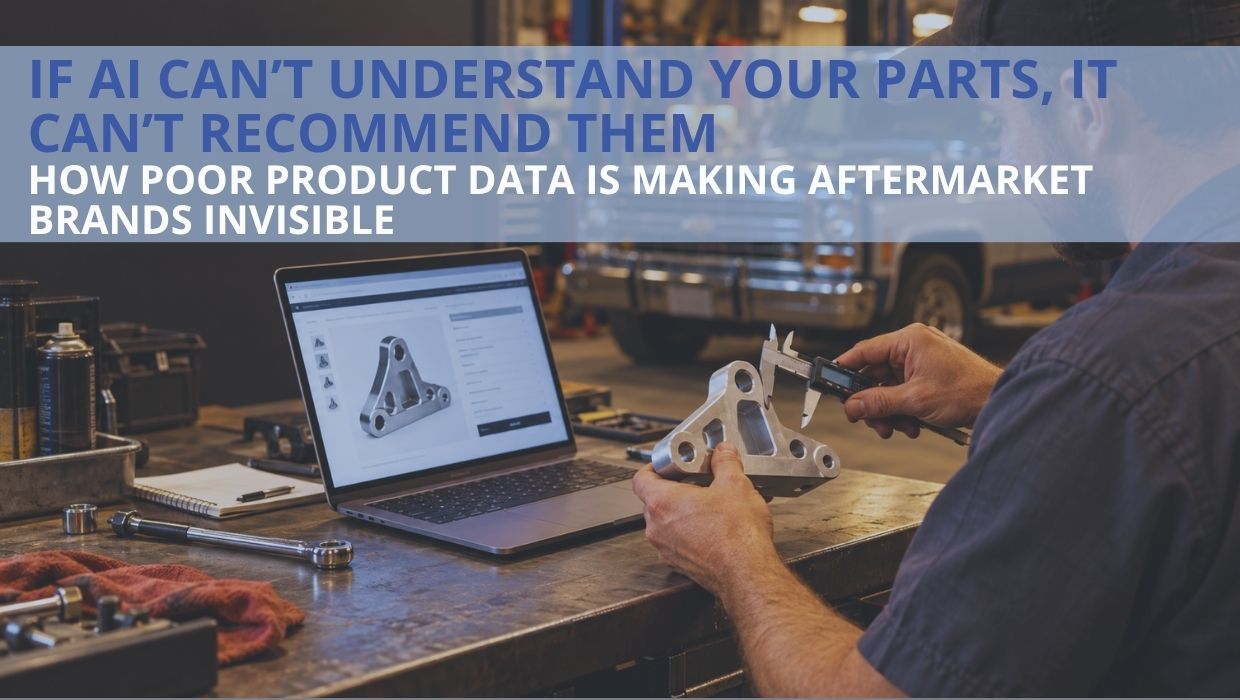
How Poor Product Data Is Making Aftermarket Brands Invisible
Some of the best aftermarket parts begin with a problem on the shop floor. A bracket does not line up. An available component falls short. A custom build needs something nobody sells.
For custom shops that design, manufacture, and sell their own parts, that problem can become a new product. Sometimes it is an improved version of a familiar part. Sometimes nothing as it existed before.
But the knowledge behind that solution has to travel beyond the shop. Customers and AI search tools need to understand what you built, what it solves, and where it works.
Accurate aftermarket product data helps search engines and AI tools understand what a part is, which vehicles it fits, and when it may be relevant. Missing specifications, vague descriptions, and conflicting fitment information make those connections harder.
That gap can cost you visibility before a buyer ever reaches your website.
Why Does Product Data Matter for AI Search?
Because AI search tools pull from your product pages to answer buyer questions, incomplete data can keep your parts out of the answer.
A search for “C10 suspension” leaves plenty open to interpretation. A question like “What suspension setup works for a lowered C10 that still gets driven on the highway?” asks for context, compatibility, and tradeoffs.
Google says its AI search features can explore related searches and sources to answer complex questions. A useful answer might draw on product pages, technical guides, and other supporting content. As we covered in
AI’s Place in Automotive Aftermarket Shops, AI-powered part searches are already changing how buyers research and hunt for components.
Your website needs enough detail to explain where your product belongs in that conversation.
Good data does not guarantee an AI recommendation. Google’s guidance also says established SEO practices still apply, and no special AI markup is required. Clear, accessible information remains the foundation.
What Makes an Aftermarket Product Page Incomplete?
A product page is incomplete when a buyer cannot confirm what the part is, whether it fits, and what else the install requires.
Consider this description: “Premium construction. Improved performance. Easy installation.”
That could sell a thousand different parts. It tells a buyer almost nothing about this one.
A useful product page should identify:
- The exact product: brand, part number, product type, and relevant identifiers.
- Verified fitment: year, make, model, and applicable engine, drivetrain, trim, or chassis details.
- Specifications: materials, dimensions, finish, capacity, and other meaningful measurements.
- Installation requirements: modifications, additional components, and what comes in the box.
- Limitations: excluded configurations and conditions that affect compatibility.
For a hypothetical brake conversion kit, “fits classic trucks” leaves critical questions unanswered. Which trucks? Which spindle configuration? What wheel clearance is required? Are brake lines included?
Those details help buyers decide and give search systems more specific information to work with. The stakes rise as vehicles age. In our post on
the
12.8-year vehicle, we looked at how an older fleet makes accurate fitment data and technical support even more important when the vehicles on the road span decades.
What If Your Shop Designed the Part?
If your shop designed the part, your page has to do the explaining, because no established catalog description exists to do it for you.
Name the component in plain language alongside your branded product name. Describe the problem it solves, the application it was developed for, and the configurations you have verified.
For an improved version of an existing part, explain exactly what changed and why it matters. Document differences in materials, geometry, mounting, or clearance where relevant. Support performance claims with testing.
Fitment also needs context. Mid-year production changes, an engine swap, an aftermarket chassis, or a previous brake conversion can make year, make, and model insufficient. A part proven on your shop’s build is not automatically verified for every similar vehicle.
State those boundaries clearly.
The industry already has standards for organizing this information. The Auto Care Association’s
ACES and PIES standards serve different purposes: ACES communicates product fitment, while PIES communicates product information.
SEMA Data supports manufacturers in managing and distributing standardized product data. These resources can help keep catalogs consistent across sales channels.
Check what actually appears on your website. Important qualifiers can disappear between your master catalog, ecommerce platform, and reseller listings.
How Do FAQs and Installation Guides Help?
FAQs and installation guides put the answers your team already gives customers where buyers and search tools can find them.
Your technical support team knows which questions come before a purchase and which ones arrive after the box is opened. Start there.
Does this kit work with factory components? What must be purchased separately? Will installation require cutting or drilling? Which measurements should the buyer confirm?
Answer each question directly, using verified product information. Place product-specific answers on the relevant page and link to the full installation guide.
Keep essential specifications and fitment notes in readable webpage text, even when you also provide a downloadable manual. Buyers should not have to hunt through a scanned diagram to discover a purchase-changing limitation.
This is practical answer engine optimization, or AEO: organizing your expertise so individual questions have clear, useful answers. Straight answers also build the kind of confidence we wrote about inTrust, Loyalty & Relationships: The Real Shop Advantage, because trust often starts before a customer ever calls.
The information your team repeats on the phone belongs somewhere customers can find it.
Does Product Schema Solve the Problem?
No. Product schema helps, but it cannot fix weak product information.
Product schema is structured data added to a webpage to label product information for search engines.
Google’s product documentation explains how it can support richer product appearances in search.
Use it to reinforce accurate information. It cannot repair a vague description or validate an unsupported fitment claim.
Have your web team check that the markup matches the visible page and that prices, availability, and product details stay consistent with any shopping feeds.
Technical improvements cannot replace accurate product documentation.
Where Should Aftermarket Brands Start?
Start with ten products.
Pick the ones that sell well, generate repeated questions, or come back because customers misunderstood compatibility. Include your shop’s own parts, especially new launches. Review each page alongside the person who designed or installs the product.
Fill in missing specifications. Resolve conflicting fitment notes. Add the questions your team actually hears. Link the correct instructions, and assign responsibility for keeping everything current.
Then watch product-page sales, relevant search traffic, support questions, and return reasons. Those measures can show whether the information is helping real buyers.
At Motorhead Digital, we approach aftermarket marketing with the customer’s actual decision in mind. A great-looking website has to explain what you sell and help people take the next step. Our
Authority Maximizer™
program turns your shop’s knowledge into blog and website content that answers customer questions and supports your visibility in Google and AI search.
You solved the problem on the shop floor. Make sure your product page explains that solution just as clearly.
Talk with Motorhead Digital
about making your website content clearer, more useful, and easier to find.
If you're ready to shift your shop's website, email marketing, or social media into high gear,
contact
Motorhead Digital
today. Let's build a strategy that drives real traffic, and real builds- straight to your shop doors.