
Motorhead Articles
Get Your Marketing in Gear
Why Ignoring Your Prospects and Clients is Costing You Money
Welcome to article 4 in our Why Ignoring Series…
On the surface, you might think that you're giving prospects all the attention they need to make a purchase, enquire about your products and services, and contact you in relation to a project or purchase of a product.

But a lot of things go into a customer journey, and if you ignore or neglect any step of it, your prospects can fall off the tracks and end up not doing business with you. Not paying enough attention to your user journey can even cause you to inadvertently neglect current clients, which will cost you money.
Losing out on a sale or a customer having a bad experience because your customer journey wasn't up to snuff can be incredibly frustrating.
So, before you continue your day, take a look at our guide on how you can stop losing money by accidentally ignoring your current and potential clients.
What is the customer journey?
The customer journey or the “Customer Engagement Lifecycle” as some would call it, is the journey your prospect, then ultimately your client, takes when interacting with your company. It can be browsing your social media, checking out your website, even as simple as interacting with your email series or with you on a phone call.
The customer journey starts the moment your potential client makes contact with your brand. If you want to make sure they keep interacting with you and ultimately make a purchase, you're going to have to make sure there are no holes in the journey ahead.
This journey tells the story of your customer's experiences with your brand. Everything they do to interact with your company contributes to their journey. Whether they're interacting with you on social media, via email, over the phone, in person, or even just on your website. Even after they've made a purchase, they're still on the journey with you.
Now we’re not saying you're doing this on purpose but hey we all get busy and tend to let things fall off the radar. That call that was not returned, an email that was missed or a review that was not responded to. We don’t mean to but when we’re trying to run a successful business things happen.
Mapping out the customer journey for your particular business will help you make sure you're not ignoring any of your prospects. It'll ensure that no prospect or customer slips through the cracks.
What is customer journey mapping?
Customer journey mapping is a strategy that helps businesses gain insight into their customers' pain points. It helps you learn how to optimize and personalize your customer experience.
By mapping out their journey, you'll be able to create a visual story of your customer's interactions with your brand.
This lets you see your business from the eyes of your potential clients. It helps you improve the customer journey so you don't lose out on any possible leads.
Mapping your customer's journey has a lot of advantages, including:
- Optimizing your customer onboarding process
- Staying in contact with every client and being there when they need you
- Understanding the differences in buyer personas
- Filling in gaps in your buyer journey
- Ensuring that no prospect gets missed or overlooked
How can the customer journey help you stop ignoring clients?
Let's say you send out an email series to all your newsletter subscribers. They'll receive that email, open it up and read what you have to say. They're incredibly interested in what you've written and the advice you're giving in your email from start to finish.
They're sold on your services by the end of the email and want to work with you. So far, the customer journey has been perfect, and you've hit every mark, but when they get to the very bottom of the email, there's no CTA (call to action).
The lack of a call to action at the bottom of the email will create a standstill for your prospect. They don't know what to do next, so they'll close the email. If you for example, in this scenario had added a call to action that read 'contact us today' or 'call us for a quote,' then the prospect might actually contact you rather than doing nothing. Sometimes we have to lead them a bit.
Analyzing the customer journey and pinpointing any major holes or cracks in your marketing strategy process will help you fine-tune your efforts. It'll help ensure that not a single potential client slips through the cracks in your customer journey.
So the next time you compose an email, update your website copy, or post an ad, remember to view it through the eyes of your potential client. Take a look and see if there's anything that would stop your client from leaving the path they're on without converting.
This is just one example of how to look at just one aspect of any business process.
How do you map out a customer journey?
Mapping out a customer journey is an easy and effective strategy to use for your business.
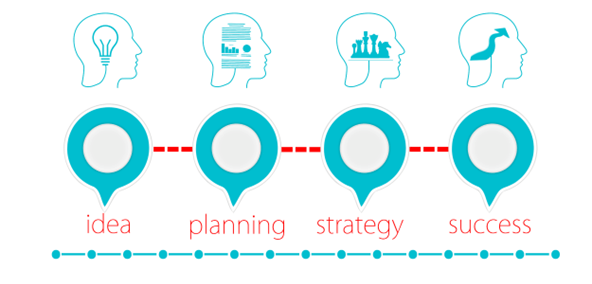
Here are four simple steps to follow to help you understand how to effectively map out and understand your customer journey.
1. Always focus on the customer intent
Remember to put yourself in your customer's shoes when planning out the customer journey. Your clients are why your brand exists, so you have to consider their needs before anybody else.
Many people forget this detail and focus on their marketing, SEO, social media, and branding strategies without taking into account how your prospects and clients are interacting with your brand.
Start by asking yourself:
- Are your clients satisfied with their experience?
- Is your website easy to navigate?
- Can they get all the information they need?
These are all questions you should be asking yourself! If the answer to any of these is no, you have some work to do!
During our research of auto restoration, performance, race, and restyling aftermarket shops, we noticed that
55% of shop websites looked unprofessional. These days
94% of your visitor’s first impressions come from your website design alone! From the start this may ruin the customer journey and makes people feel uneasy about working with you.
If your website isn't up to date and easy to use, you're going to lose out on money by not paying attention to the needs of your prospects.
Remember that if your brick-and-mortar store looks bad on the outside, clients are just going to drive on by. The same can be said about your website. So, make sure your website looks attractive to your potential clients.
This is just one example but there are so many other customer touchpoints besides your website that you’ll want to look at.
2. Pay close attention to customer touchpoints
Every single time your potential clients come in contact with your brand - whether it's before, during, or after they've converted - you have an opportunity to improve your profits.
All these interactions are known as touchpoints.
Examples of touchpoints are:
- When your user interacts with an ad on social media
- Comments on social media
- Visits your website
- Fills our a contact us form on your website
- Has a phone conversation with you, or
- Leaves a review on your Google Business Profile
By paying close attention to these different touchpoints, you'll be able to identify the cracks within your customer's journey and fix them.
Suppose there are no obstacles for your customer to face. Then they'll have an easy and pleasant time interacting with your brand.
This will improve the chances of you getting and keeping them as a returning customer, which is a lot more profitable for your business.
3. Create a graphic to guide you
Creating an easy-to-understand graphic for your customer journey map will help highlight when your customers stop interacting (The cracks) with your brand or get frustrated.
This is where your team can move in, adjust your strategy eliminating the cracks, and create a seamless customer journey for your prospects.
It's impossible to anticipate every possible scenario that's going to happen between your touchpoints and your potential clients. But finding the pain points of the journey and making them more straightforward is a crucial step forward.
Having a graph full of valuable customer data is key to understanding your client's behavior. It'll allow you to fix the problems and identify where you're succeeding too.
4. Engage with your clients
Customer engagement is key to securing as many quality clients as you can effectively support and service. But getting those new customers is only the start. When you’re working on a project for a client the worst thing you could do is ignore them while your working on their project by not keeping them updated on the progress as well as the ongoing costs.
How to engage with your client throughout the project
When you first start your project talk to your client and bring them in to see your shop. Show them where the magic happens and where you’ll be transforming their ride into something spectacular.
Give them a tour of your shop, spray booth, dyno, engine build area, and even your office! Don’t forget to show them all the materials and equipment you’ll be using and explain what everything does to give them a uniquely immersive experience. They’ll end up appreciating the work you do a lot more if you get them involved from the start!
You’ll also want to introduce your client to your entire team so they can get to know the crew that’ll be working on the project. This will create a more personal service which will increase the chance of word-of-mouth referrals and repeat business.
To make things extra special for your client consider documenting everything from start to finish and build a project book that contains everything that went into the project. This is an excellent gift to give your clients as it’ll have a detailed history of the project and all the work you put in to make their ride look as awesome as possible.
Customer engagement isn’t something that only happens over social media. You can and should engage with your customers over:
- Private message
- Zoom
- Website chat
- Telephone
- Face-to-face
Don’t be that shop that leaves them in the dark while you work. Instead, ask for their cell number or email so you can continuously update them throughout the entire project. Send them text messages or email them images of what you’re working on. Live updates allow your client to feel more involved with the project - it is their car you’re working on after all.
You can continually keep your clients updated with all kinds of things to get them excited about the completion of their project.
They’ll love to see:
- Parts and component fitment tests
- Parts you’re selecting to use on their car
- New parts being installed and tested
- Their car on the Dyno and the results
- Paint color, fabric, and other styling choices
- Realtime progress photos
- Paint tests spray out cards for color matching
- Engine build and test runs
- Before and after shots - also perfect for uploading to your social media!
Even if you’re only updating your client with a few small things now and then they’ll be delighted to get your message. People love to see every little detail that goes into their project because it makes them feel more involved with the experience. Plus, they might share the pictures on social media and tag your shop - giving you some excellent exposure online.
Make time for your clients they’re what keeps your business going and the more you share with them the more respect and confidence they’ll have for you and your abilities.
Remember to pay attention to your current clients as well as your prospects!
Paying attention to your prospects is excellent - you're not going to lose out on any money this way!
But, you should also pay close attention to your current clients as well.
Did you know that it can cost up to
6 to 7 times more to capture a new customer than to retain a current one? Increasing your customer retention by just
5% can also boost your profits by 25% to 95%!
Retaining your customers can be expensive, but it's a lot cheaper than the amount of work you have to put in to make a successful sale again.
Plus, this client will already know how you work. You'll already know what they like and it might be fun to work on another project with a client you've worked with before.
If you want help mapping out your customer journey or need a hand retaining those important, high-profile clients, then give
Motorhead Digital a call to make sure you're not losing out on money by ignoring your clients.
Get in contact with our experts today to stop losing out on money by ignoring your prospects and clients. Let us handle everything for you and get your shop the conversions it deserves.